
Energy Control

Create controlled decision alternatives for time-sensitive energy operations.
Intraday energy decisions depend on more than buying at a low price and selling at a high price. Price, generation, consumption, storage state, contractual constraints, network conditions, imbalance exposure, transaction costs and uncertainty interact continuously.
NEURIXA Energy Control is designed to bring these factors into a shared, time-aware decision context and support operators with reviewable alternatives.
The operational challenge
Relevant information arrives at different frequencies and with different quality. Forecasts change, storage flexibility is limited, market opportunities expire and an apparently attractive transaction may create imbalance or operational risk elsewhere.
The capability therefore focuses on coordinated context, not on a single prediction.
How the capability works
Build a common energy position
Measured values, forecasts, schedules, contracts, market information and storage conditions can be aligned to a consistent time model and operating horizon.
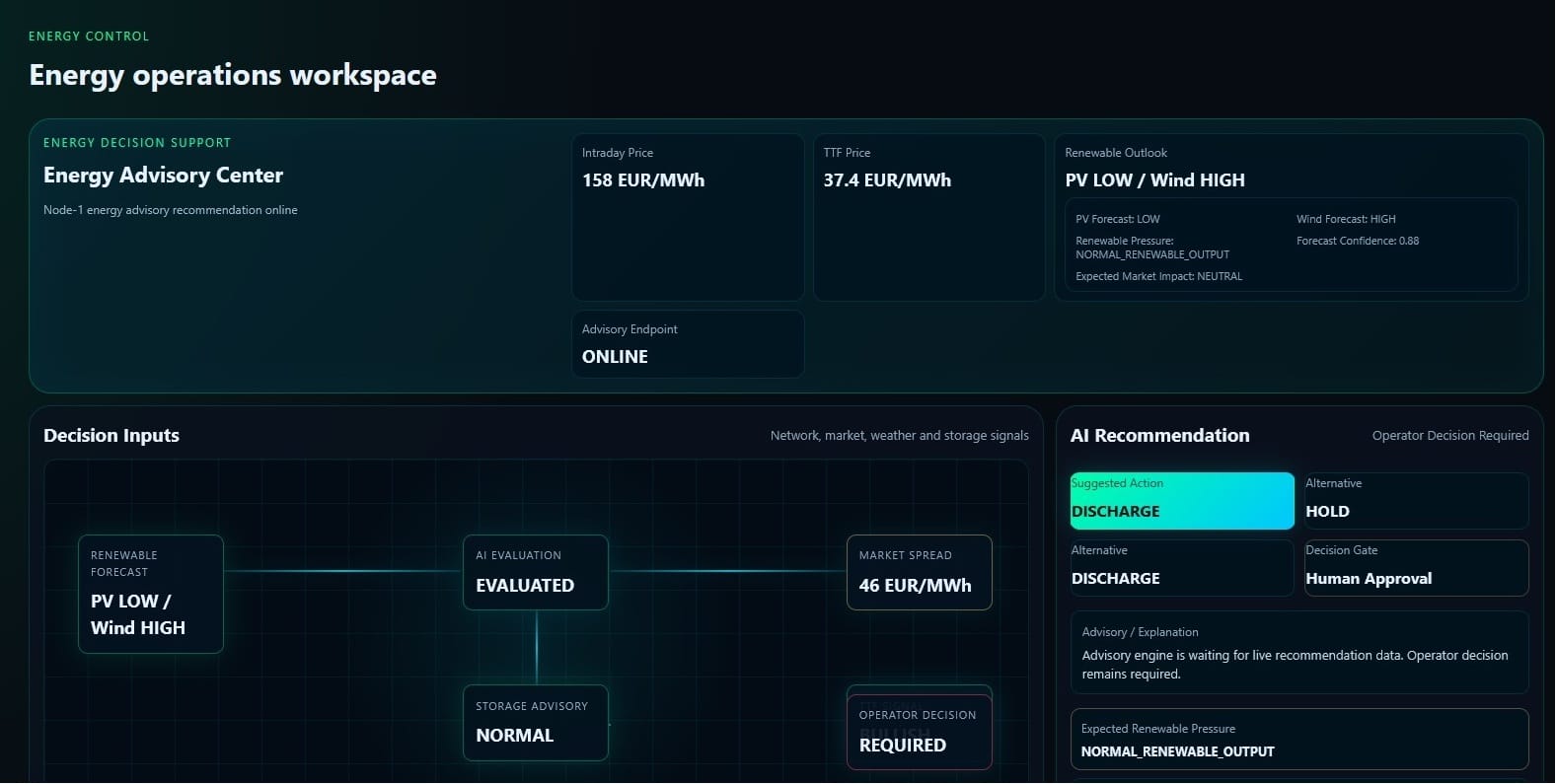
Actual NEURIXA Energy Control workspace shown with demonstration data.Check quality and constraints
Missing, delayed or inconsistent data must be visible. Physical, contractual and operational limits constrain which alternatives are genuinely feasible.
Compare decision alternatives
Potential actions can be assessed together with cost, risk, uncertainty and expected operational impact. The output is an explainable alternative, not an unexplained command.
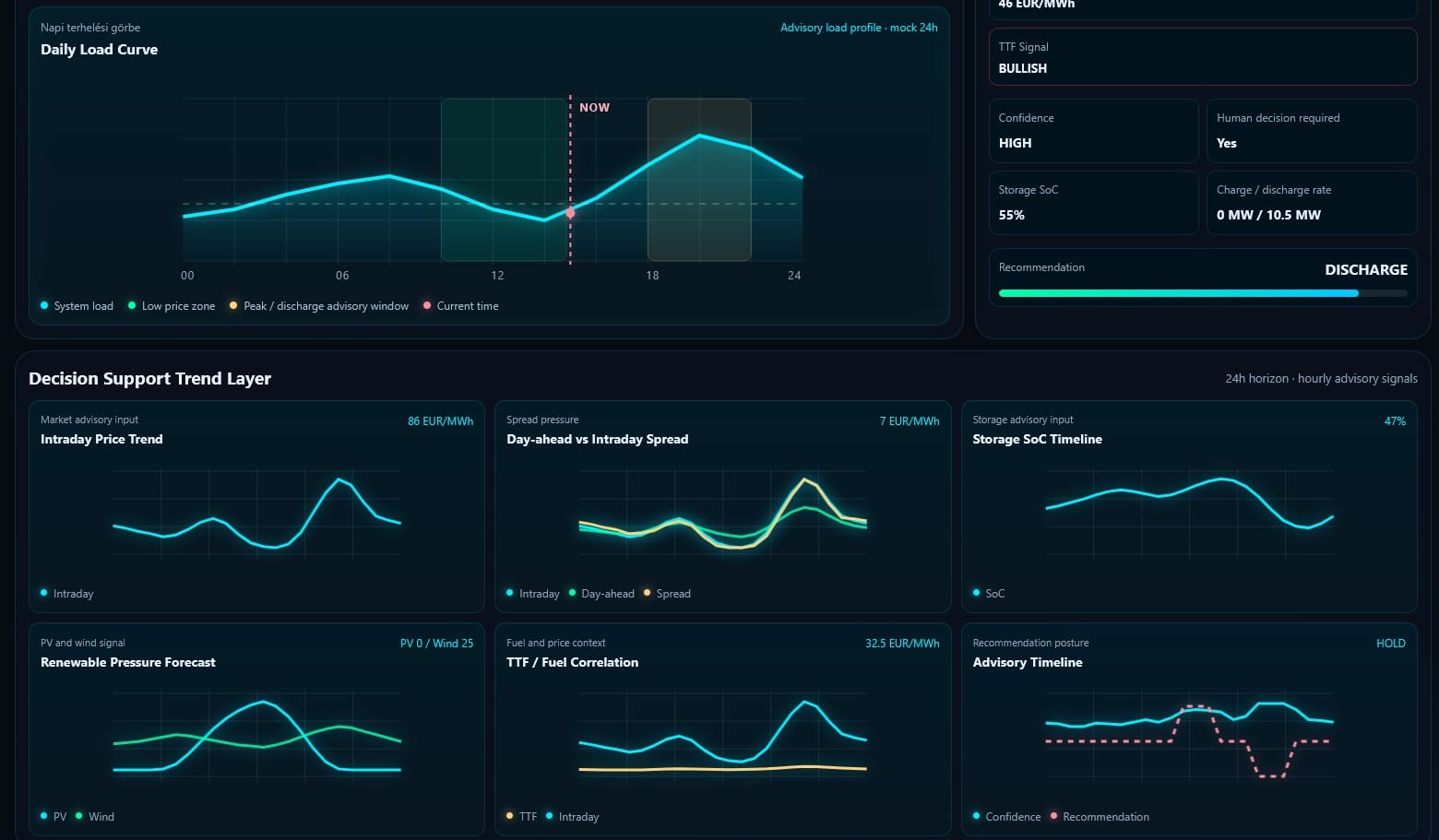
NEURIXA Energy Control decision-support trends shown with demonstration data.Validate with operators
Operators review the assumptions, signals and constraints behind the proposed alternative. Acceptance criteria and pilot results can be measured against actual operational value.
Example: storage and imbalance
A battery may appear available for an intraday market opportunity. The decision changes when state of charge, expected demand, reserve obligations, efficiency losses, network constraints and imbalance exposure are evaluated together.
Energy Control can support comparison of feasible alternatives and show which inputs and constraints shaped the result. The authorised operator remains responsible for execution.
Typical applications
- intraday market decision support;
- consumption and generation context;
- storage and flexibility assessment;
- imbalance and reserve interpretation;
- scenario comparison under uncertainty;
- operator-centred pilot and validation workflows.
Energy Control is not Energy Security
Energy Control focuses on operational and economic alternatives within defined constraints. Energy Security focuses on recognising dangerous system states and supporting grid-stability and security-of-supply decisions. They can share context, but their objectives and authority remain distinct.